Friday, January 4, 2013

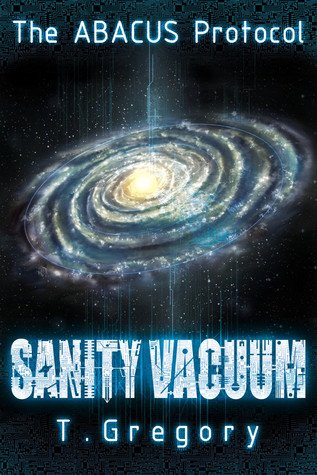
The Abacus Protocol: Sanity Vacuum - Review

I received this book from the publisher through Net Galley.


I'm always interested in science fiction books especially those about future colonies and New World type things this was sort of that way in that it takes place in the 31st century when space colonies are nothing new. What is new for the protagonist is that she's getting a new job she's always been very interested in artificial intelligence and supercomputers. Our protagonist, Vivian Skye, is from a small colony planet that doesn't like the idea of supercomputers. In fact, Vivian's family has ostracized her because of her interest in her study at school into this realm of science. Now that Vivian has graduated, her first job is very exciting to her; she is going to be working and isolated Extra-Galactic Observatory with one of the original AI computers that is close to sentience. But of course no one wants any of the AI computers to be sentient. That's what the Abacus Protocol is all about--to make certain that the computers do not become sentient.

At the Observatory, there are two scientists and a tech who maintains all of the space mechanical equipment, and there is her boss, Bryce Zimmer who oversees it all. Vivian's job is to study the computer, do updates and basic maintenance to see that everything is working well. Unfortunately, she discovers that no maintenance has been done on the AI, whose name is quirk--that's, quIRK--, for nearly 12 years. Quirk has a personality all his own that Vivian likes. Work has even had cats brought onto the station because he feels they are good for the human mindset. It's also a fact that quIRK likes the cats. A hint at his near sentence.

Everything would be working fairly well if it weren't for the fact that Zimmer, her boss, has grandiose ideas about himself and the planet that he comes from which is an oligarchy and he is trying to get back to the top rung of the political heap. Not only is his planet and oligarchs setup based on old Earth Rome, but he's also a chauvinist. He sees Vivian as a threat. He manages to put a sub-routine in quIRK's programming that causes various accidents to Vivian. His neuroses become so great that it threatens the entire space station. During all this quIRK become sentiment.

The writing in this story was very good. I could picture each scene and imagine the space station and all people very well. I like stories that are visually pleasing through words. Thea Greg's background in physics and other sciences has made this story very believable. Character development was good, and Vivian Skye, is quite likable.

The download I received for my Kindle had some formatting problems: lost paragraphing between dialogue, run-on sentences, and such. This surprised me, since I follow the Curiosity Quills (the publisher) blog, where several articles have been posted about e-book presentation. I hope the formatting for the final product has been cleaned up.

I had a bit of trouble with the ending. It seemed a little too tidy and rushed. There were several things that didn't really add up to the detail that had been in other parts of the book.

Overall, I enjoyed the story. This was subtitled, Sanity Vacuum, and I get the feeling there might be another ABACUS Protocol story in the works.

The ABACUS Protocol


Wednesday, January 2, 2013

Publishers: Did You Know?

It's a well-known fact that most of the major publishing houses have consolidated and merged and rearranged themselves many times over. This has affected magazines as well as book publishers; many of the controlling holding companies are not in the U.S.

Simon & Schuster, is an exception. Founded in New York City in 1924, S&S is currently owned by CBS. Still headquartered in NYC, it is a bastion of fiction and nonfiction, producing more than 1000 titles a year from 35 different imprints, including Pocket Books, Scribner, Atria, Fireside, Touchstone, and Atheneum Books for Young Readers.

Baen Books is a more recent stalwart of American publishing. It was founded in 1983 when a huge reorganization of Simon & Schuster was underway. S&S approached Jim Baen with an offer for him to head up the S&S science fiction line (Pocket Books division). Baen, however, had different plans. He obtained financial backing from some friends and proposed to start a new company named Baen Books. The deal was done and, at the beginning, Simon & Schuster handled the distribution.

Unfortunately, many of the book publishers we have taken for granted as being American-owned and run no longer hold that distinction.

  • Houghton Mifflin Company, founded in Boston in 1832, is now HMH (Houghton-Mifflin-Harcourt), with the company having purchased Harcourt (formerly Harcourt Brace Jovanovich) in 2007. Several mergers and buyouts have ensued and HMH is now owned by Education Media and Publishing Group (EMPG), an international holding company registered in the Cayman Island. HMH is a leader in the educational publications marketplace. NOTE: Although primaries in EMPG are from Ireland, one of the major investors is Guggenheim Partners, a U.S. investment corporation.
  • Alfred A Knopf, Inc founded in 1915, was purchased by Random House in 1960. Random House also bought Doubleday, and now there's a KnopfDoubleday company under the RH umbrella. It's a publishing consortium of its own, with a half dozen or so imprints. Random House, Inc. has been owned since 1998 by the German mega-media company, Bertelsmann.
  • The Free Press was founded in 1947, became an imprint of Simon & Schuster, was sold in 1960 and merged into the Macmillan Publishing Company. Macmillian, founded in London, opened its first U.S. offices in 1969. It is now part of the large German holding company, Georg von Holtzbrinck. MacMillan's American publishers include Farrar Straus and Giroux, Henry Holt & Company, Bedford/St. Martin’s, Picador, Roaring Brook Press, St. Martin’s Press, Tor Books, and others.
The publisher umbrellas have a wide span, with most of the imprints belonging to three or four houses. Along with S&S, Random House, Harper-Collins, and Penguin Group (USA) produce the majority of books we see on commercial bookshelves across the country. Former independent companies have become imprints: Farrar Straus, Henry Holt, Little Brown; and some have vanished (Fawcett, Carol Graf, Arbor).

But there are plenty of small and Indie publishers. Check out the Wikipedia page to see the more than 500 companies that are competing with the big guys.

Tuesday, January 1, 2013

Words and Meanings

There are many whimsical lists around that give words with the same spelling and vastly different meanings. Most often those words are from different parts of speech--comparing a verb to a noun (wind up the clock vs. the wind blew hard).

But here are some nouns that are spelled the same and have different meanings. I pulled these randomly from Webster's Collegiate Dictionary, Eleventh edition.
  • tender (n)
    1) an unconditional offer of money or service in satisfaction of a debt or obligation made to save a penalty of forfeiture for nonpayment or nonperformance.
    2) one that tends as a ship employed to attend other ships (e.g. to supply provisions).
  • barrow (n)
    1) a large mound of earth or stones over the remains of the dead.
    2) a male hog castrated before sexual maturity.
    3) a cart with a shallow box body, two wheels, and shafts for pushing it.
  • date (n)
    1) the oblong edible fruit of a palm
    2) the time at which an event occurs
  • gimlet (n)
    1) a small tool with a screw point, grooved shank, and cross handle for boring holes.
    2) a drink consisting of sweetened lime juice and gin or vodka and sometimes carbonated or plain water.
This list could get quite long, but I'm stopping with the word (second meaning) I like best. :-)

HAPPY NEW YEAR!