Showing posts with label science fiction. Show all posts

Friday, October 23, 2015

Word Events for November


Contact GITP with events in your area. We'll add them to the list.

Thursday, August 6, 2015

Derelict: Halcyone Space - REVIEW

Reviewed by Kae Cheatham


LJ Cohen
August 2012
ISBN 978-0-9847870-7-4
ASIN: B00KNFS8OW


Hard science fiction is not a genre I usual select, but this came with a strong recommendation. Dueling spaceships is not the focus. Rather, LJ Cohen has written a human conflict of will and emotion amplified by the circumstances of the derelict freighter, Halcyone, suddenly re-energizing and carrying four young people on a wild ride through space. Various unexpected events kept me reading. Here's the publisher overview:
"When Rosalen [Ro] Maldonado tinkers with the derelict freighter, she's just hoping to prove she deserves a scholarship to University. She certainly doesn't count on waking the ship's damaged AI or having three stowaways, Micah Rotherwood and brothers Jem and Barre Durbin, along for the ride. They all have their private reasons for hiding aboard and lives they are seeking to escape, but if the accidental crew can't work together and learn to trust each other, they'll die together, victims of a computer that doesn't realize the war ended decades before any of them were even born."

Programming and artificial intelligence are big parts of this story. The information of what is being done is well described, and I (programming novice) had no trouble following the ins and outs of the many problems Ro has in her attempt to fix Halcyon. I appreciated the speculative elements of what future programming and AI communication might well become. I’ve read several articles that hint at what Cohen has build into her story.


Most compelling was the excellent construction of the different characters. Cohen has developed each with a strong personality and well-explained skill sets. Each felt hard done by their circumstances, but reacted in different ways: Barre, an exceptional musician, turns to drugs; Ro becomes an engineering workaholic; Micah lets revenge be motivation, while Jem, the youngest, is super eager to do what he most loves—programming. All of their unique abilities are vital to extricating them from dangerous plans of smugglers and pursuit by their own government.


This is the first book of a series, and I already have the second book on my e-reader. Looking forward to it.

Monday, January 13, 2014

Bad Glass - Review

Bad Glass
© 2012 Richard E. Gropp
isbn13: 9780345533937
Del Rey

I borrowed the eBook version from my Public Library's online Overdrive system.


I like this book. I didn't like the characters too much. But that isn't a criterion of mine in order to like a book. Bad Glass is well written, with dynamic characters that sustain throughout the story. The landscape is vivid and believable, even when events and circumstances are very unusual. I like speculative fiction that makes me think and wonder, and keeps me curious about what is going to happen. Gropp's Bad Glass certainly did this.

Dean Walker, the first-person narrator, is a young man who professes to be looking for a way to make his mark in the world. He is a photographer and he goes to Spokane with the hopes of getting exceptional photos that will stamp his name on the profession of photojournalism. Spokane has been off the maps for several months before the Dean gets there. Strange occurrences are going on in the city, and no one has been able to explain what or why. The military are there; they have cordoned off the entire area, not allowing anyone in or out. Dean must sneak into the city, and once there he observes very odd occurrences that he cannot explain. The city is in chaos--a sublime chaos, actually. Dean is robbed of his supplies but rescued by the lovely Taylor. Dean is intrigued with her and readily accepts her invitation to stay at a large house with her and several other people. Bolstered with booze, pot and eventually prescription drugs, Dean attempts to become closer with Taylor while he continues to take photographs he can smuggle out to Internet forums.

Spokane seems to be in an alternate reality. All of the subordinate characters are richly drawn and believable. I was curious about each of them, and wanted to know how they would fare under the odd circumstances. Dean's view of what is happening is not reliable because of the drugs he's been taking; even he admits this at several points. Nonetheless he has photographs which seem to substantiate the curious state of affairs in Spokane. The ending was intriguing, and even after reading the cryptic last chapter, I still had doubts about what had happened.

But this is what made me like the book. I'm still thinking about it, several days after finishing. And I know in a few months when I go back and see the title, I will remember the book quite vividly.

This title was a Bram Stoker Award Nominee for Superior Achievement in a First Novel (2012)

Sunday, January 5, 2014

The Explorer - Review

The Explorer
by James Smythe © 2013
HarperCollins
ISBN 9780062229519

I borrowed this Kindle ebook from my Public Library online Overdrive system.

Three parts. First person. Speculative fiction.
The official book blurb:
When journalist Cormac Easton is selected to document the first manned mission into deep space, he dreams of securing his place in history as one of humanity's great explorers.
But in space, nothing goes according to plan.
The crew wake from hypersleep to discover their captain dead in his allegedly fail-proof safety pod. They mourn, and Cormac sends a beautifully written eulogy back to Earth. The word from ground control is unequivocal: no matter what happens, the mission must continue.
But as the body count begins to rise, Cormac finds himself alone and spiraling toward his own inevitable death...unless he can do something to stop it.
I was drawn to James Smythe's The Explorer, by the intriguing cover design. I found the writing good and the emotions of protagonist of Cormac Easton believable. I didn't like or dislike him--was merely curious to see where the events led. The psychological elements of crew interaction are interesting, but hinge greatly on information that is given in dibs and dabs throughout the book; perspective of them keeps changing. Some of the science elements seems sketchy, but since the story is from Cormac's POV (and he's a science Luddite) maybe that doesn't matter.

I felt the story strung out a bit too long, especially the flashbacks to Cormac's life and dissolving marriage to Elena. Cormac-on-the-ground is boring. I found myself skimming much of Part 2 and 3 because it seemed repetitive with just slightly different slants from before. I realize this repetition is some of the essence of the story and meant to build tension; I wasn't tense. Toward the end, I studied what I read more closely to understand the denouement of the story. This prompted me to return to earlier parts of the book, because a few things didn't jibe. Even on re-reading, certain major factors didn't work.

I don't want to tell too much because I hate giving spoilers. Best I can do is to say The Explorer is something each reader has to experience without forewarning. The review responses on Goodreads run the gamut from 5-star to 1-star. Whatever, it's a good mental exercise to see if you can figure out what's happening.

Sunday, December 29, 2013

Have Wormhole, Will Travel - Review

Tony McFadden’s speculative fiction story, Have Wormhole, Will Travel, is set in Australia and the descriptions of Sydney and the bay are nicely done. The story starts with a woman, Sabrina, certain that she has identified vampires. She is actually seeing two aliens--Callum, and Jacob. They (and many other aliens) have been hanging around Earth for more than 400 years. Sabrina enlists her friend, Mandy, into her attempt to prove these two men are vampires. Sabrina also mentions her beliefs to another friend, Jackie.

Along with the young women who are pursuing Callum and Jacob to see if they are vampires, there is the element of potential Earth destruction. It seems that Callum and Jacob are from a distant planet where the civilization monitors other sentient worlds, looking for advancement that could become a threat to their own planet and culture. When Callum reports that scientist Sam Sheppard is close to developing wormhole travel, his superiors decide that the sentients on Earth must be eliminated. (Sam Sheppard's sort-of girlfriend is, conveniently, Jackie.) Callum doesn’t like the decision to wipe out Earth’s humans, and tries to sabotage the scientist’s work.

There are some funny bits in this story and the characters of Sabrina, Jackie and Mandy are well developed. Callum and Jacob are indistinguishable until the last third of the book. The science presented is done in an articulate manner, but I don't know enough about string theory and wormholes to be able to say if any of it was sufficiently and scientifically accurate--even on a speculative level. Maybe that doesn't matter.

The third person presentation works well, especially to give the actions and reactions of the many characters. In all, Have Wormhole, Will Travel is an upbeat read, although I found much of the story a bit glib.

Thursday, January 17, 2013

Obliterated - Review


C.J. Hall has written an interesting story about a future apocalypse and surviving it. Set in the Southwest, Obliterated begins with a woman hearing noises and looking to downtown area and seeing a lot of destruction. The destruction is being caused by some otherworldly type vehicles in the air. She begins getting things together so that she can leave her house. She calls her husband and they take to the hills. The way they survive, trying to avoid the invaders as well as people who are panicking because of all the destruction, is extremely interesting and very well researched. The description of the hills and mountains where they take refuge is very believable.

I don't know that I would have as much common sense as was shown by the characters in this book. The subtitle, Would you know how to survive, is very apropos. I don't think most people would know how to proceed if their world was suddenly devastated and they were forced to live by their wiles.

The alien invasion was a good setup for this type of a story, but it could just as easily have been some horrible natural disaster, or political upheaval. By giving it the space invaders touch, Hall has managed to keep this from seeming like a extremists survival manual. Some of the information got a bit long but at the same time it was all very important, and is especially important if you are interested in knowing what to do under circumstances similar to these.

Characters were distinctive, although the dialogue often got lengthy. Generally well written.

Friday, January 4, 2013

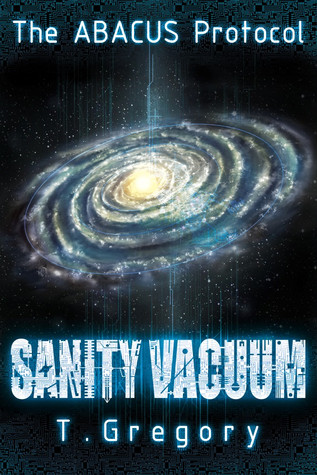
The Abacus Protocol: Sanity Vacuum - Review

I received this book from the publisher through Net Galley.


I'm always interested in science fiction books especially those about future colonies and New World type things this was sort of that way in that it takes place in the 31st century when space colonies are nothing new. What is new for the protagonist is that she's getting a new job she's always been very interested in artificial intelligence and supercomputers. Our protagonist, Vivian Skye, is from a small colony planet that doesn't like the idea of supercomputers. In fact, Vivian's family has ostracized her because of her interest in her study at school into this realm of science. Now that Vivian has graduated, her first job is very exciting to her; she is going to be working and isolated Extra-Galactic Observatory with one of the original AI computers that is close to sentience. But of course no one wants any of the AI computers to be sentient. That's what the Abacus Protocol is all about--to make certain that the computers do not become sentient.

At the Observatory, there are two scientists and a tech who maintains all of the space mechanical equipment, and there is her boss, Bryce Zimmer who oversees it all. Vivian's job is to study the computer, do updates and basic maintenance to see that everything is working well. Unfortunately, she discovers that no maintenance has been done on the AI, whose name is quirk--that's, quIRK--, for nearly 12 years. Quirk has a personality all his own that Vivian likes. Work has even had cats brought onto the station because he feels they are good for the human mindset. It's also a fact that quIRK likes the cats. A hint at his near sentence.

Everything would be working fairly well if it weren't for the fact that Zimmer, her boss, has grandiose ideas about himself and the planet that he comes from which is an oligarchy and he is trying to get back to the top rung of the political heap. Not only is his planet and oligarchs setup based on old Earth Rome, but he's also a chauvinist. He sees Vivian as a threat. He manages to put a sub-routine in quIRK's programming that causes various accidents to Vivian. His neuroses become so great that it threatens the entire space station. During all this quIRK become sentiment.

The writing in this story was very good. I could picture each scene and imagine the space station and all people very well. I like stories that are visually pleasing through words. Thea Greg's background in physics and other sciences has made this story very believable. Character development was good, and Vivian Skye, is quite likable.

The download I received for my Kindle had some formatting problems: lost paragraphing between dialogue, run-on sentences, and such. This surprised me, since I follow the Curiosity Quills (the publisher) blog, where several articles have been posted about e-book presentation. I hope the formatting for the final product has been cleaned up.

I had a bit of trouble with the ending. It seemed a little too tidy and rushed. There were several things that didn't really add up to the detail that had been in other parts of the book.

Overall, I enjoyed the story. This was subtitled, Sanity Vacuum, and I get the feeling there might be another ABACUS Protocol story in the works.

The ABACUS Protocol


Friday, March 2, 2012

Hotel Carousel – Review

What fun! I really enjoyed S.H. Hughes' book Hotel Carousel. Science Fiction mystery, with sometimes kitschy humor. Neat. I downloaded it after reading an overview on an online site.

From the book page:
Janski Fox had a plan. Buy gold Armani Wellingtons on her credit card. Obtain a refund. Now she's over 24,000,000,000,000 miles from home irradiating drain hair to repay the debt. When a chewing gum failure destroys the ship taking Janski to join a mineral ore mining team, what's left crashes at the Hotel Carousel, where a non-paying guest soon realises Janski is the perfect mouthpiece to help it confess its crimes--hopefully she won't die like the others did! As well as staying alive, Janski must prove she's not a jewel thief, outwit a bunch of Psi officers wishing to excavate her mind, convince a mad professor that scooping out her brain isn't such a good idea and save Muse, a royal fugitive who has the genetic hots for her. And then there are the manoeuvring tests... Hotel Carousel: All Aliens Welcome!

I finished this book several weeks ago, and due to myriad complications just got a chance to write the review. I didn't have to go back to the book to find names, situations, etc., because I remembered them all. A sign I enjoyed the book.

The omniscient narrator keeps the story from getting out of hand, and also inserts these great descriptions of the "guests" at Hotel Carousel. They're all from somewhere else, and since Janski is totally out of this galaxy--very few of them (except Muse) resemble anything she knows. But this telling about aliens doesn't get overdone. It's applied skillfully and when needed.

All the characters were distinguishable not just by their quirky alienness, but with distinct personalities that played throughout the book. The several mystery elements were straightforward, which is important in a book with so many peculiar characteristics. Along with sleuthing to save her job (and her life) Janski is involved in action scenes that are believable and well portrayed.

Hotel Caoursel is witty, well written and a fun read.

Friday, January 13, 2012

Pure - Review

My copy of PURE came from the publishers through netgalley.com

I read a lot of Science Fiction, but dystopian stories aren't usually the ones I choose. I often find them a bit overwhelming with their dismal view of the future. Of course, that's what dystopian stories are about, but many of them focus more on this wrecked and depressing future than on the characters. I like a character-driven story. The titles I've read that give me the characters I can care about have been by Octavia Butler and Paolo Bacigalupi. I'm sure more authors would meet my criteria, but I haven't found them...until now. I've added Juilianna Baggott to this list.

From the Goodreads book page:
"Pressia barely remembers the Detonations or much about life during the Before. In her sleeping cabinet behind the rubble of an old barbershop where she lives with her grandfather, she thinks about what is lost--how the world went from amusement parks, movie theaters, birthday parties, fathers and mothers...to ash and dust, scars, permanent burns, and fused, damaged bodies. And now, at an age when everyone is required to turn themselves over to the militia to either be trained as a soldier or, if they are too damaged and weak, to be used as live targets, Pressia can no longer pretend to be small.

This overview of Pure snagged my attention, and the character of Pressia pulled me in to her story of surviving a fractured and disturbing world, where odd wraiths can attack from underground, where finding food and water is a hopeful consideration, and where deformities are the norm...deformities such as Pressia's where the doll she was holding when Detonations happened is now permanently fused to her hand. Her physical change is nothing compared to other people. Her grandfather has a fan lodged in his throat that whirrs as he breathes. Her friend, Bradwell, has birds embedded on his back—still alive and living through him. Everyone has some odd alteration...Except for the Pures

The Pures have become nearly mythical, even though everyone can look up to where they live in a massive hermetically-sealed Dome. That thriving mini city is home to people without deformities, without starvation and attacks by Groupies (a multi-fused people gang). A place some wish they could get to, while other want it destroyed.

When Pressia meets the Pure, Partridge, who was driven out of the Dome by his need to find his mother, she learns new things about herself and the blasted world around her. How she assimilates her new knowledge is deftly told. Her emotions, often conflicting, about Pures and the Before, are realistic and heart-wrenching. Partridge, too, is a fascinating character. Through him and another Pure, Lyda, life within the Dome is presented not just as a camera-view of this future place, but with the emotional needs of the characters.

Baggott is noted for her excellent YA fiction, and while the major characters of Pure are in their youth, the story and writing offer excellence for anyone. Although I noted a few plot line conundrums, I won't mention them because 1) they were small and would also be Spoilers, and 2) I was reading an ARC--these aspects in the final book might be different.

Without reservation, I recommended Pure as a fascinating, well written story. It's also the first book in a series. I look forward to the next.

Friday, December 2, 2011

Patrick Patterson and the World of Others – Review

I read an author interview at Kindle Author and decided to purchase this book.

I really enjoyed James Edward Fryar's book, Patrick Patterson and the World of Others. It's a fresh voice and a different story from SciFi I've recently read.

The story (excerpted from the book page):
For almost thirteen years, Patrick Patterson has lived a quiet, simple life in the tiny town at the edge of Texas, called Farwell, but he is suddenly whisked away by a rag tag group of warriors and others across the United States to discover his true identity and a destiny clouded in mystery.
Never in his wildest dreams did he think that he'd walk through an underground city filled with citizens from across the universe, contend with powerful enemies from the edge of the galaxy, or travel to the Arctic Circle on a high speed train.
Now, he must decide what he truly desires and whether he even wants to take up the mantle of hero...or alien.

So we're in the present, with aliens among us, and we don't even know it. Patrick didn't know it either, until right before his thirteenth birthday. Then he gets to meet these aliens--up close and personal, and some are pretty gruesome.

Fryar seamlessly melds the fantastic into the common place, and accepting the story is easy. The characters help with this, as they are believable--especially their emotions. The story moved along well, but wasn't predictable. There were a few glitches (aren't there always?), such as irregular sentence structure:

"Patrick found a greasy woman cooking at the stove that he assumed was Pratt's wife"

??the stove is Pratt's wife?? But these were few and offset by some nice language:

"...cars like tiny bubbles of oxygen through the vein of the enclosed Lincoln Tunnel, and back out, into the beating heart of Times Square".

I particularly like the overall presentation; what is shown in the prologue, was important to the entire story, and ties up nicely at the end.

But it isn't quite The End, because Patrick, after he escapes the nasty, alien baddies, still has to make his trip to a distant planet (the true World of Others) and face his destiny. I look forward to the next book.

Friday, November 18, 2011

Corsair (Outer Pendulum, Part 1) – Review

I paid for a download of Corsair after reading a 200-word excerpt on Indie Snippets.

This short-story length hard science fiction, takes place on a flagship of an armada. I'm not a big fan of hard SF, and the Indie Snippet's post didn't really indicate this genre. The snippet spoke of slavery and mining colonies. Nonetheless, I read on, pleased by the competent writing and good descriptions.

The Commander of the armada, Eli Saffinger, is well described both physically and emotionally. He has revenge on his mind, as he hopes to engage the alien commander who destroyed a cruise liner, killing more than 1000 people. The battle scene is quickly set, and proceeds with action fit for a TV screen.

It was all over rather quickly and I think it should have been fleshed out to at least be a novella (~60,000 words). It ends with hints of more to come (This is Part 1, after all).

Friday, July 1, 2011

No Hero - Review

I received the publisher's e-ARC of Jonathan Wood's No Hero from netgalley.
Publication date: ~19 July 2011
Publisher: Night Shade Books

From the publisher: "What would Kurt Russell do?" Oxford police detective Arthur Wallace asks himself that question a lot. Because Arthur is no hero. He's a good cop, but prefers that action and heroics remain on the screen, safely performed by professionals. But then, secretive government agency MI12 [MI37] comes calling, hoping to recruit Arthur in their struggle against the tentacled horrors from another dimension known as the Progeny. But Arthur is NO HERO! Can an everyman stand against sanity-ripping cosmic horrors?"

I really liked the first-person non-hero, Arthur Wallace. Jonathan Wood has written this character with style and personality that grabs the reader from the opening page. The supporting cast are also well written, from the loquacious science guy to the steampunk cyber authority, and the "Let's stick to business" leader of MI37. No Hero is an action Sci Fi adventure akin to the movies Men in Black and, Arthur's favorite, Big Trouble in Little China. In No Hero the aliens are seeping through from another reality—an updated version of the usual "world is doomed" scenario. This is also a popular theme in SF right now, with true science speculating on different universe dimensions with different physical properties. The idea is that our universe has a membrane that secludes us from different entities and physics.

I especially like Wallace's continual shock that he is in a real "save the world" situation—sometimes he is exhilarated, but most often is aghast at his position in it all. His frustration at not really knowing what is happening is palpable. The whole idea of another dimension is as alien to him as the aliens.

But, there were story problems—or actually, elements in action adventures that usually gripe me. Jonathan Wood wrote from the accepted rules of the genre and did a fine job, but I am always bummed by the ineffective "good guys" who have limited skills, power, etc. while the "bad guys" (in this case the Progeny) seem invincible. I suppose this is to get the reader to cheer for the underdog. I could accept the underdog role of Wallace and his MI37 team, but the supposed Keepers of the Status Quo Between Realities (the Dreamers) were a bunch of duffs. And while Wallace was frustrated with inadequate information, the final action scenes left me frustrated with the continual deflection of any real answers or presentation of what was really happening. I still can't figure why the Dreamers were so ineffective. Nor could I figure out how people like The Sheilas (and a few others) came to be.

The potential for further books with Arthur Wallace and MI37 fighting anomalies of the universe is clearly set up, and for all that I don't often like some of the devices of this genre, I know I'll grab the next Wood books and enjoy the action and unique situations.

Saturday, May 21, 2011

The Sixth Discipline

I bought the kindle edition of The Sixth Discipline after reading about it on Kindle Author Interviews.

Carmen Webster Buxton's The Sixth Discipline is a far-future story that has strong elements of world building—a feature that always interests me. A distant planet is called Haven by the people who settled there. Several factions formed at land fall; they dispersed to different parts of the hospitable planet.

Ran-Del Jahanpur is part of the Sansoussy, who believe in living with the land. By design, their development in the forests remains basic to needs; but they also have a variety of psi abilities. While out hunting, Ran-Del is kidnapped by some technologically-advanced people from the progressive city of Shangri-la. His captivity remains a mystery to him as he is treated well and introduced to the contrary marvels of the city.

Here enters a Romance side of the story, as we meet Francesca Hayden, whose father engineered Ran-Del's kidnap. He intends for Francesca and Ran-Del to marry. Romance, yes; but not heavy-handed with the expected genre standards of distrust, jealousy, and misunderstandings. Instead, the story of why Ran-Del is the perfect husband choice for Francesca, and the politics of Shangri-la guide the story.

The story shifts back to the Sansoussy Forest and Ran-Del's family—especially his great-grandfather who sees what is in Ran-Del's future. Movement between these two regions on the planet shows the cultural development of each in realistic fashion. All the characters are sharply drawn and believable, from the dock-side workers who become Ran-Del's friends, to Ran-Del's grandmother who is unsure of the very modern Francesca. The final resolutions include Sansoussy rituals and political maneuvering in Shangri-la. Tension is high and the outcome satisfactory. A good read (great cover, too).

Sunday, March 6, 2011

ECHO - Review

Jack McDevitt is a master at presenting humanity of the future in terms we can identify with today. ECHO is a fine example of this. In the far future, when people are flung throughout several galaxies, ECHO shows how humanity still yearns to answer a basic question: Are we alone? Are other sentient, conversant people somewhere primed for contact?

In ECHO, antiquarian Alex Benedict (this is the fifth book in the series) is curious about an artifact he see advertised for sale. It has unknown glyphs on it and is very large. Benedict learns the object once belonged to the late Sunset Tuttle--a man renown for his SETI-type searches. The object goes missing, and all Benedict has are visual facsimiles. When he sets out to investigate what happened to the object, events become both puzzling and dangerous.

This pursuit is not handled solely by Benedict. Although he initially recognizes a mystery that begins the adventure and always deduces the solution, the Benedict novels are written as first-person accounts by Chase Kolpath. Chase is the administrative assistant for Benedict's antiquities company. She is also Benedict's pilot, both on world and off; when action heats up, Chase is at the center of conflict resolution.

Each adventure (book) is a memoir, recording Chase’s perspective of events. She sets the story down for people of her era, although she often puts in asides: "The station’s name, as you probably know, is Tsarendipol..." (page 104). On page 288, after a particularly dangerous misadventure, she shrugs off Benedict's apology and writes, "...when I started putting this memoir together, I'd intended to leave this sequence out...Alex advised me to tell the whole story."

This styling of the book allows a casual comfort when the future technology and circumstances are related. Nothing is overly explained and it’s easy to accept everything presented, such as jackets that, when you put them on, automatically adjust heating for different temperatures (I wish I had one of those!). The language and writing are strong.

As a mystery, the unfolding story of what happened to the object and why has abundant tension, a few red herrings and plenty of action. ECHO is a 2011 Nebula nominee, and I wouldn't be surprised if Jack McDevitt takes top honors.

Wednesday, November 10, 2010

Bright of the Sky - Review

Bright of the Sky (Entire and the Rose, #1)Bright of the Sky by Kay Kenyon
My rating: 3 of 5 stars

I downloaded this eBook after reading a blurb about it in Kindle Nations (I think).

I liked the writing, the concept and the characterizations. The beginning was a bit slow, with the introduction of characters that weren't even necessary to the true story. The point of view shifted a lot, and it took me many pages before I realized who was the main protagonist. Once I got to that point, I found the action very dynamic; it kept me "turning" the pages and wondering what would happen next.

Why isn't this a 4-star or more? Partly because of the tedious beginning, and then because of several glitches in the storyline where information seemed thrown in or inconsistent with what was previously told.

I imagine I'll read book 2--again, because of the good character development. I want to know what happens to these people.

View all my reviews